
More than ever, mental health should be our priority. Follow this monthly wellness planner to make this year the happiest year ever.
Goals are only dreams without a plan. At the beginning of each year, I will break down my yearly goals into small steps and create a monthly planner.
For the past few years, career and finance have taken up more than 90% of my planner slots. But how have I been feeling? What have I done to improve my mental health? I have no idea.
The past two years has been a roller-coaster. Many of us, I included, are still navigating through the new normal. More than ever, our mental strength is put to the test.
So for this year, I’ve created a monthly wellness planner to keep myself accountable. Feel free to follow these mental health exercises with me, or create your own!
Monthly wellness planner
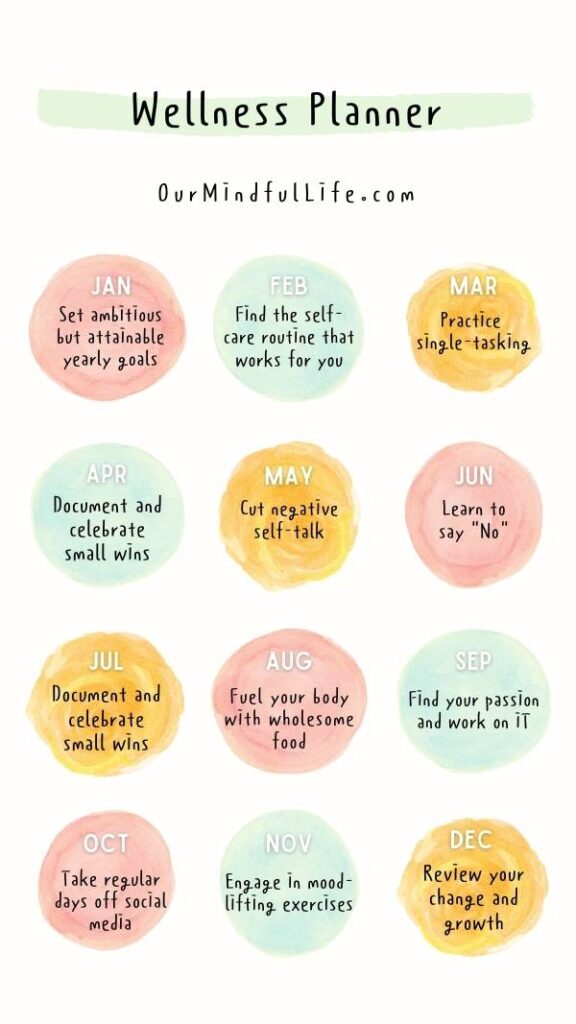
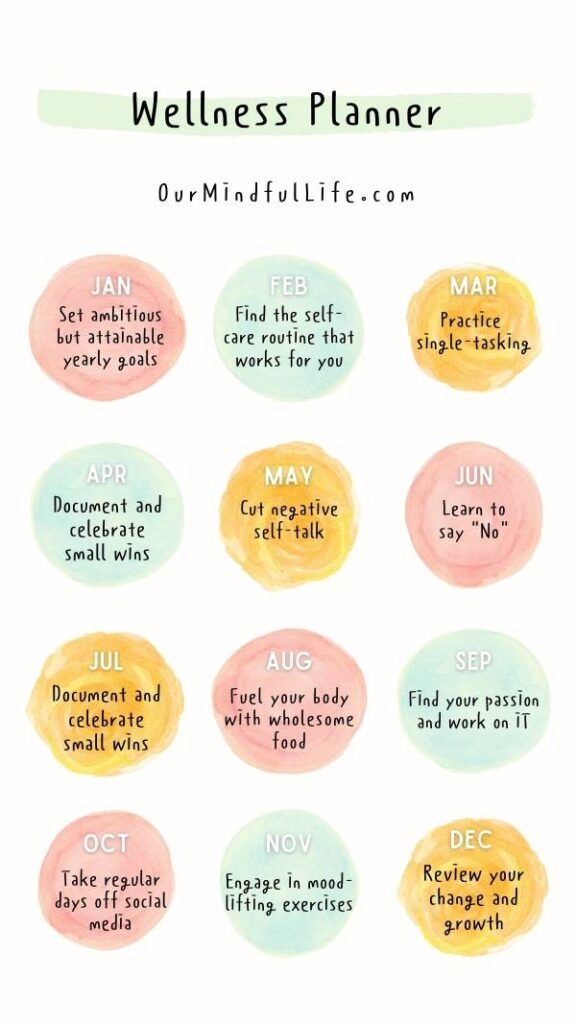
January: Set ambitious and attainable goals
Most of my New Year resolutions were left undone last year. Instead of focusing on dreaded items, I am making a list of SMART goals this year.
S.M.A.R.T. goal-setting looks like:
Specific: clear and well defined
Measurable: Include precise amounts to value the degree of success
Attainable: possible to achieve
Relevant: keep goals aligned with career or life
Time-Bound: have a deadline
I use the Notion app to track my progress. You can also use your bullet journal, a notepad, or whatever fits you. Save your record to somewhere you can refer to anytime.
Read also: 36 Goal Quotes On Setting and Achieving Your Goals
February: Find the self-care routine that works for you
Self-care used to stress me instead of making me feel relax. A celebrity-approved morning ritual can be a lot to ask on a busy day. That’s why it’s ok to dedicate the entire February to find the self-care routine that suits you.
Try different self-care ideas, note down your feelings, and keep experimenting. What works for someone else doesn’t necessarily work for you. You have the best knowledge and control over your health and mental wellbeing.
March:
How many tabs are open on your browser now? More than 3? You are not alone.
Multi-tasking was once considered to be productive. But science has proven otherwise. Switching between different tasks can consume massive brainpower and attention.
Mono-tasking, or single-tasking, brings various benefits. By focusing on one thing, it boosts our efficiency, creativity, and overall performance. So for March, give yourself a little challenge and start doing one thing at a time.
April: Document and celebrate small wins
Having goals is one thing; keeping the momentum going is another. Documenting your progress boosts your motivation and lifts your mood.
“Replying all the emails” or “getting praise from a customer” may sound like nothing. But these smalls wins remind us of how far we have come.
May: Cut negative self-talk
Every time you tell yourself, “I can’t do this,” your subconsciousness is convinced of your limitations. What you tell yourself is not necessarily true. Sometimes it’s our mind that holds us back.
If you have trouble shutting up your inner critic, try talking to yourself like talking with a friend. If you don’t tell your friend “you are never going to make it,” then don’t do it to yourself either.
Instead, ask yourself how you can make it happen. List your options and make a plan. A productive thinking pattern can be a game-changer for your mental health and your success.
June: Learn to say “No”
You can be a good person and still turn down unreasonable requests. By setting up your boundaries, you write the guidelines of how you want to be treated. Here are 6 steps to build and keep your boundaries.
July: Acknowledge your feelings
One lesson I learned in 2020 is the more you try to avoid your feelings, the stronger they become. Self-acceptance is the first step of healing.Next time when you blame yourself for feeling sad, press pause and ask yourself:
“Why am I sad? Am I the one responsible? Anything I can do to change that?” Take a step back and observe your emotions. By switching your mindset, your emotions will stop owning you.
August: Fuel your body with wholesome food
Find the food that makes you feel good and energetic. Try new recipes and see how your body likes them. You are what you eat. So make sure you are feeding your body the right way.
September: Find your passion and work on it
Passions give us a reason to keep learning and growing. It doesn’t have to be something you are good at. If you love drawing as a kid, go ahead and pick it up. A purpose lights the fire in you and will make your everyday life more meaningful.
October: Take regular days off social media
Scrolling is not resting. Unplug one day a week to give your mind a break and restore your mental energy.
November: Engage in mood-lifting exercises
Not everyone enjoys going to the gym four days a week. Dancing, jogging, yoga, and walking can all keep you active and energetic. Try different exercises and stick to the ones that cheer you up.
December: Review your change and growth
What is your biggest change this year? What lessons have you learned? December is the month to reflect. Here are some year-end review questions to see how well you are doing and make better plans for the year to come.
So that’s it for the monthly wellness planner. What are you doing this year to boost your mental health? Comment down below or D.M. @_ourmindfullife on Instagram to share your thoughts!