
Excessive positivity can be dangerous. Here are the toxic positivity examples and how to avoid it.
Positivity helps us to handle crises and difficult situations with strength and hope. But just like everything, too much is not always better. When we force ourselves to be positive all the time, we may fall victim to toxic positivity or fake positivity.
So what is toxic positivity?
By definition, toxic positivity refers to “excessive and ineffective overgeneralization of a happy, optimistic state across all situations.”
Imagine going through a breakup; you browse through funny memes hoping for a laugh. And a quote saying “everything will be ok” pops up on your feed. Will you feel ok instantly, or will you be mad?
I would be the latter. As a blogger, I’ve written quotes that encourage positivity. But they don’t always work.
A quote of “keep going, and you’ll be there” might give you a glimpse of hope for some time. But it doesn’t answer the question of where you should be going and why you are not there in the first place. Excessive positivity leaves no room for us to validate our feelings and to figure out the real problems.
So how do you know if you are going too far? And how do you avoid toxic positivity? Here are some examples for a quick self-check.
Examples of toxic positivity
What toxic positivity is like when you talk to others
Whether you are trying to cheer a friend up or comfort someone grieving, the following lines might not do what they are supposed to do.
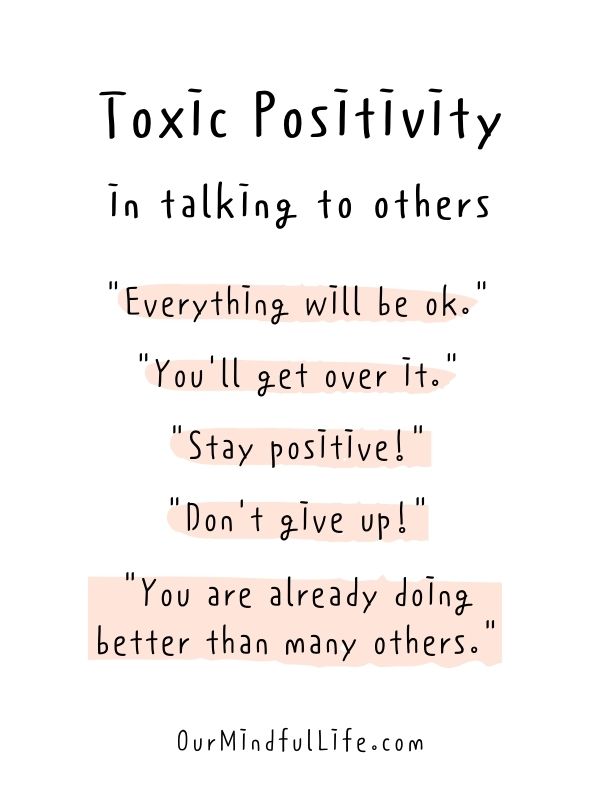

“Everything will be ok.”
Well, things are not ok at the moment. And no one knows for sure if the situation will get better soon. By saying “everything will be ok,” you are making claims you are not sure about.
“You’ll get over it.”
Yes, people heal, eventually. But healing is a long and complicated process. It may take months or even years to grieve one’s loss or to bounce back from failure. By saying “you’ll get over it”, you over-simplify the healing process as a straight line from point A to point B. It’s ignoring or denying the difficulty to heal.


“Stay positive!”
Positivity is not an answer to all questions. For example, if your friend loses his job because he doesn’t have the skills for it, positivity will not help him find out his problems. The danger of “good vibes only” could blind us from where the issues are.
“Don’t give up!”
Knowing what is not suitable for you is precious. You will not get to the destination no matter how fast you run in the wrong direction.


“You are already doing better than many others.”
Comparing someone’s misery to others is not a good place to begin with. Firstly, by saying so, you fail to validate the feelings and sufferings of the person. And what you imply with the line is that “you are being dramatic because, look at others!”
Everyone grieves and heals differently, and the fact that someone is doing worse doesn’t make things better.
What toxic positivity is like when you talk to yourself


You can also force a positive attitude on yourself, and here’s what it looks like.
“Quitting is not an option.”
Quitting on the first attempt can be a sign of emotional weakness. But it’s a different case if you have given your best and things still didn’t work out.
Again, knowing what’s not for you is precious. And thoughtfully switching paths is something we should normalize.
“Tears are for losers.”
You can heal if you keep hiding your wounds. Your emotions make you human. Crying is a way to release stress. Research shows that up to 80% of people feel better after crying.
And winning is multi-dimensional. You can excel in your career and your relationships even if you cry now and then. To attach your worth to how you handle emotions would be reckless.
“Chin up 24/7.”
No one except for psychopaths can be all happy all the time. You are not feeling sad for no reason. And our emotions are indicators of our mental health.
Negative emotions are signs that you need to take a break and do your inner work. When we honor our feelings, both the good ones and the bad ones, we become more self-aware and calm.


“Work harder, and things will work out.”
The harsh truth is that sometimes hard work doesn’t always pay off. For example, a toxic relationship with a narcissist won’t go anywhere no matter how hard you try.
By pushing yourself to “work harder,” you ignore other reasons why things are not working in the first place. And you are putting all the blame on the lack of your effort.
How to avoid toxic positivity
Listen before you speak
This is particularly true when you are trying to comfort someone. Sometimes it’s not your intention to pressure your friend to be positive. It’s just that you are not paying enough attention to what the person wants to say. So you try to end the uncomfortable conversation with a “you are going to be ok”.
The thing is, you don’t always need to provide a solution or a promise. Sometimes people want to be heard, to be seen, and be understood. Instead of “you will be fine”, try saying “This must be difficult”, “I feel your pain” or “I am here if you need a shoulder to cry on.”


Words of encouragement should come from understanding and empathy, not ignorance and avoidance.
Know that things can be bad and better at the same time
One common belief behind toxic positivity is that a situation is either good or bad. And the misconception forces our brain to choose sides. But that’s far from the truth.
When you break your ankle, suffering is unavoidable. Denial doesn’t make the pain go away. But each day, you feel a little better. It sucks a little less day by day. When you stop forcing yourself to see only the “good vibes”, it takes the pressure off your shoulder.
Analyze and adjust
Ironically, we hear the line “just be positive” mostly in negative situations. It’s convenient to turn a blind eye to the real problems. But you don’t solve what you avoid.


Instead of jumping to the conclusion, take some time to analyze why things are not ok at the moment. For example, if you are tired all the time at work, instead of blindly injecting yourself with motivational quotes, try to dig deeper into the reasons behind it.
Is it because the work itself bores you? Or maybe your efforts are not appreciated by your superior? Or perhaps you need to improve your time management skills. Locate the problem area and make changes accordingly.
Have you ever suffered from toxic positivity?
Share your experience in the comment!