
A mandalart, or mandalart chart, is a tool for organizing ideas and thoughts. Learn how to use it with examples and a free template.
“You don’t need motivation. You need clarity.”
For me, clarity is essential but rare. A lot of the times when I feel unmotivated, it’s not because I am lazy. It’s because I am unclear about what we want and how to get there.
When was the last time you were 100% committed to a specific task and felt like time just flew by? That’s the flow state. And the lack of clarity is the Number One enemy of getting into the flow state.
So, how do you find clarity amid all the information, ideas, and choices to make?
In this post, I am introducing a tool that will help you understand what you want and the steps needed to achieve to get there so you can take purposeful actions.
Also, I will share how I use this tool – Mandalart, to organize my life and work.
The best thing about it? It’s so basic and simple, and anyone can benefit from it. I’ve been using it for a while on different occasions, and it’s been life-changing, bringing me more clarity, focus, and a sense of fulfillment.
To make things easier, I’ve created a free printable template waiting for you at the end of this post. So, you can start today. Now, let’s dive in!
What is mandalart and who is it for?
Mandalart, also known as a mandala chart or mandala planner, combines “mandala” and “chart.” It is a 3×3 9-grid chart invented by Yasuo Matsumura in 1979.
It’s an organizer, a planner, and a canvas for brainstorming ideas. But how?
A mandalart is a 3-tier system that breaks down a goal or a main idea into:
- Key idea/Purpose/Goal
- Primary aspects
- Secondary aspects of each primary aspect
By listing your aspirations, tasks, and milestones, you can prioritize and strategize while making sure all aspects thrive in balance.
A mandalart is especially helpful for those:
- Looking to set and achieve personal or professional goals.
- Seeking to improve their productivity and time management.
- In need of a creative way to plan and reflect on their progress.
- Interested in visualizing complex ideas or projects in a structured manner.
How to use a mandalart?
Mandalart is easy to use, with almost no entry barrier. Let’s first take a quick look at how each component works so you can maximize its power.
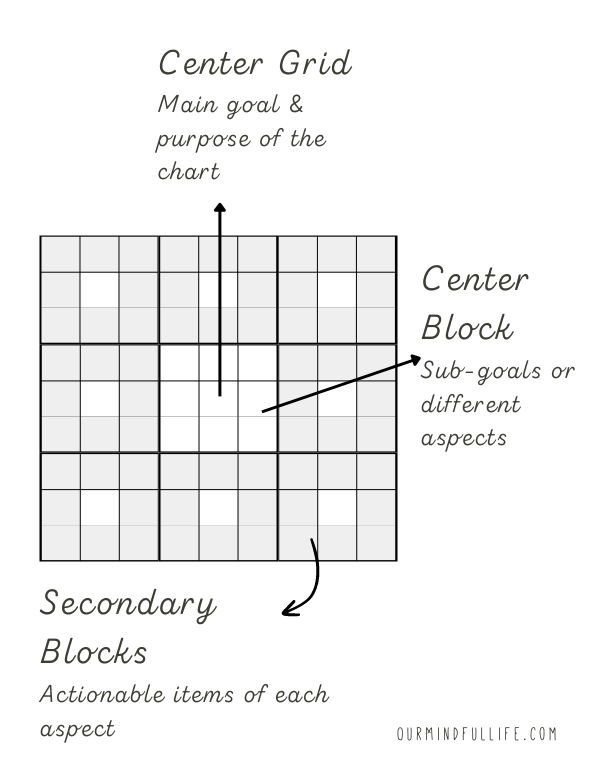
The Center Grid
The grid in the center of the chart is where you put your goal, project, or theme. It defines what the entire chart is for and serves as the focus around which all other elements revolve.
The Center Block
Refers to the 3×3 block in the center. This is where you break down your goal into eight primary aspects or sub-goals.
For example, if you are using Mandalart as a new year planner, you can put the year in the center grid. The other eight grids of the center block could be “Health,” “Career,” “Finance,” “Relationship,” “Growth,” etc.
The Secondary Blocks
The eight remaining blocks surrounding the center block. This is where you break down each primary aspect of your goal into specific action items or milestones.
For example, the “Health” section of your New Year mandalart can include:
- Workout 3 times a week
- Cut sugar
- 8 hours of sleep every day
- Gain muscle by 5% more
By further breaking your goals into these smaller, more manageable tasks, you create a roadmap for achieving them. These tasks also help keep you balanced and not miss an essential aspect.
Examples of how to use Mandalart in real life
So now you have a basic understanding of how a mandalart chart works, let’s dig deeper into some powerful ways to integrate mandalart into your life.
New Year Planner
Mandalart makes a great planning tool for the new year. You can list aspirations you wish to achieve in the following year, break down each goal, and make sure each goal is clear and well-defined.
This is how a New Year Mandalart can include:
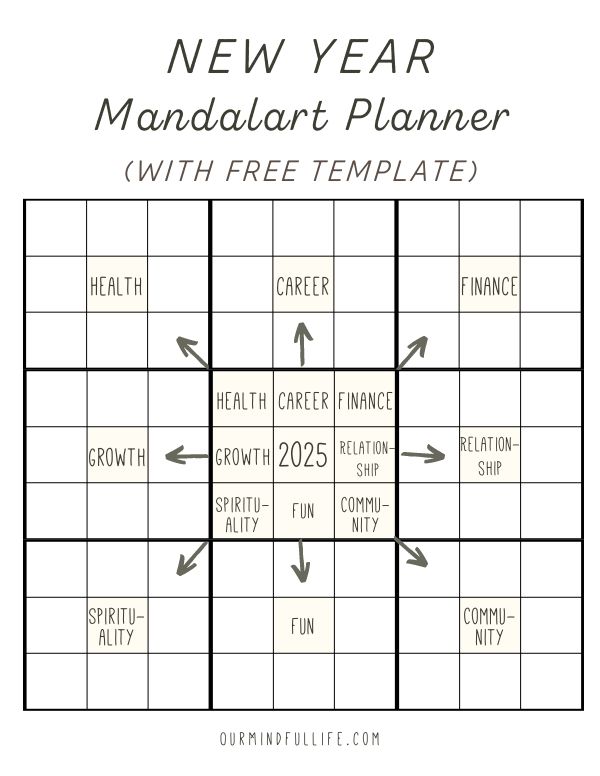
- Career: Set professional goals, such as getting a promotion, taking on new projects, switching jobs, or developing new skills.
- Finance: Plan for savings, investments, or paying off debt.
- Health: Include fitness targets, eating habits, and mental health practices like box breathing.
- Growth: Identify areas for personal or professional development, such as learning a new language or taking a course.
- Spirituality: Plan for practices that nourish your spirit, like meditation, yoga, and occasional brain dump.
- Relationship: Set intentions for nurturing personal relationships or making new connections, such as an hour each day with your kids.
- Fun: Schedule time for hobbies, entertainment, and leisure to have a balanced lifestyle.
- Community: Make a plan for how to give back to the community, such as volunteering or participating in community events.
The New Year Mandalart is not just a planning tool but also a source of motivation. It serves as a visual reminder of your ambitions and the steps you need to achieve them. It helps you visualize where you will be a year from now, giving you the tunnel vision required to do the work.
Monthly Planner
Like a New Year Planner, you can make Monthly Mandalarts and set intentions at the beginning of each month.
If you already have a Yearly Mandalart, you can keep the center block unchanged and simply highlight the primary goals you want to focus on this month. This allows you to maintain continuity with your long-term objectives while adapting to shorter-term priorities.
It’s worth noting that you don’t need to fill all the empty grids of each secondary block. Limit the number of items on the chart, just like you would with a to-do list, so it’s actionable and less overwhelming.
Here’s an example of what a Monthly Mandalart Planner might look like for June:
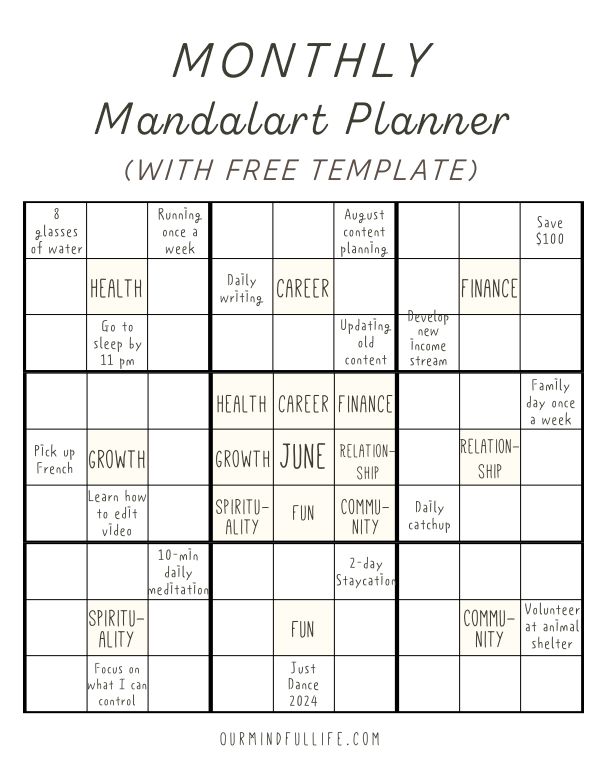
Remember, the beauty of mandalart is its flexibility. You can customize each grid to reflect what’s most important to you at any given time.
The goal is to create a visual representation of your month that inspires and guides your actions, helping you to make the most of your time and stay aligned with your intentions.
Project Management
Organization and planning are key when taking on a new project. This is where a mandalart comes in handy.
Put the name of your project in the center grid. Then, start filling in the different aspects, breaking the project into manageable components.
For example, one of my friends plans to open a small coffee shop. This is how she used the mandala to organize her thoughts and understand the scope of her venture:
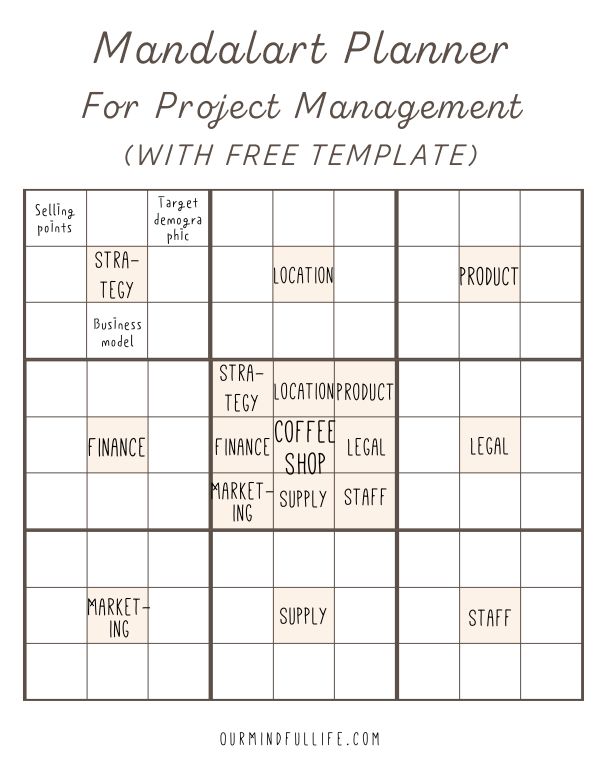
- Strategy: Define the unique selling points, target demographic, and business model.
- Location: Scout the best spots with good traffic and low competition. Negotiate on the rent and terms of the lease.
- Product: Decide on the coffee flavors and food that will keep people coming back.
- Finance: Create a detailed budget, including startup costs, operating expenses, and projected revenue.
- Legal: Obtain necessary permits, licenses, and insurance for the business.
- Marketing: Plan for online and local advertising and prepare materials for marketing campaigns.
- Supply: Look for qualified suppliers of coffee beans, equipment, etc.
- Staffing: Decide on how many people to hire, when, and how to train them.
This is just one example. You can also use it for projects like home renovation, party planning, or organizing a work event. By categorizing various elements of the project, you can gain clarity on the steps needed and what to prioritize.
Major life changes
Changes can be chaotic and overwhelming. Whether it’s moving to a new city, starting a new career, or becoming a parent, it often requires meticulous planning and strategic thinking.
If you are starting a new chapter of life or are at a pivotal moment, a mandalart planner may help you navigate the uncertainty.
Take moving to a new city, for example; your mandalart planner may look like this:
- Housing: Look for neighborhoods that suit your lifestyle, and start hunting for a place that feels like home.
- Transportation: Find the best ways to get around, whether by car, bike, public transit, or on foot.
- Employment: If you don’t already have a job lined up, search for opportunities in your field.
- Education: If you or your family need school or continuing education, find out about local schools and learning centers.
- Social life: Plan how to meet new people, join clubs, or just find fun things to do in your free time.
- Finances: Budget for the move and adjust to the cost of living in your new city.
- Healthcare: Locate nearby doctors, dentists, and hospitals, and understand your health coverage options.
- Moving: Plan the logistics of the move, from packing to hiring a moving company and setting a timeline.
By mapping out all the aspects on your mandalart, you can keep track of your transition and make sure nothing is missed before you take the leap.
Brain dumping
Brain dump means writing down the things on your mind so you can have more mental space to tackle your most important tasks.
I have created a brain dump template before. But a mandalart planner can also be used to offload your mental baggage, so you are less overwhelmed by the thoughts and ideas crowding your mind.
It’s like creating a New Year mandalart planner, but only this time you are writing down things that are currently consuming your brain energy.
It can be categorized by different areas of your life, such as “Work,” “Family,” and “Study.” It can also be broken down into specific tasks or ideas, like “Graduating,” Job Hunting,” or “Exams.”
Study
Mandalart can be a valuable tool for students and those taking a course or learning a new skill. It can work wonders because it provides a framework and helps track progress.
Take learning a new language, for example. The center grid will be the language you want to learn.
Then, use the remaining eight grids in the center block to represent different areas, like grammar, vocabulary, listening, speaking, reading, writing, culture, and pronunciation.
The final step is to fill in your Secondary Blocks. For example, you can break down “Vocabulary” into subcategories such as:
- Numbers and Quantities
- Time and Dates
- Food and Drink
By organizing your learning process with a mandalart planner, you can focus on one area at a time without losing the big picture. This can make the journey more manageable and less intimidating.
Free printable Mandala template
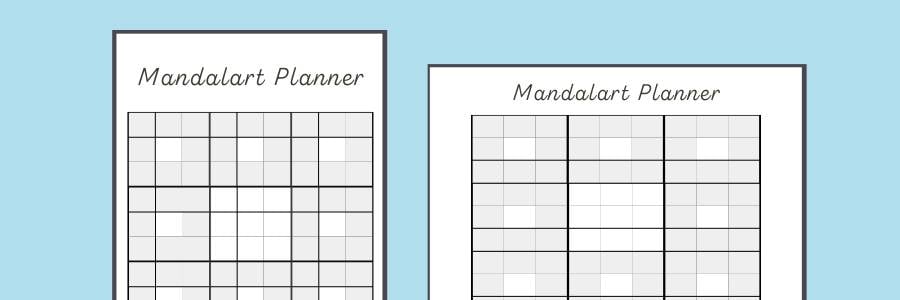
Below is a free, monochromic version of a printable mandalart template. Subscribe to our newsletter and get access to this template , plus other exclusive content and resources.
Here’s what the vertical version looks like:

If you have any questions, feel free to comment down below. Happy planning!